Friday, September 23, 2011


Thursday, July 14, 2011
Fête Nationale
Today is Bastille Day, also known as Fête Nationale. The holiday is celebrated all over France as well as several other countries.

The Bastille prison, located in Paris, was once greatly feared for the terror which occurred inside its walls. On July 14, 1789, it became a symbol of French Revolution and freedom.

La Liberté guidant le peuple (Liberty Leading The People) by Eugène Delacroix
The Bastille prison was originally called the Chastel Saint-Antoine. It was built between 1370 and 1383 under King Charles V and King Charles VI to serve as a fortress and protection of the city of Paris against Anglo-Burgundian forces during the Hundred Years' War. The four and 1/2 building was surrounded by its own moat and was located at the eastern main entrance to medieval Paris. It had eight towers which were approximately 77.1 ft. (23.5m) high. There were two courtyards and an armory.

La Bastille dans les prémiers jours de sa demolition (The Bastille Early in Its Demolition) by Hubert Robert
The storming of the Bastille occurred on July 14, 1789 and marked the beginning of the French Revolution. The event is celebrated annually on July 14 in France and many other countries and is officially called the Fête Nationale.

On the one year anniversary of the storming of the Bastille in 1790 people honored Fête de la Fédération with a huge feast to celebrate the uprising of the short-lived constitutional monarchy in France and the short lived, but successful, French Revolution. The event took place on the Champ de Mars, which was at the time far outside Paris.
A mass was given to mark the occasion and General Lafayette, captain of the National Guard of Paris, took his oath to the constitution. The celebration lasted four days with feasts, fine wine, fireworks and people running naked through the streets.

Today Bastille Day is celebrated in much the same way sans the running naked through the streets part.Will you open a bottle of wine and enjoy some lovely French bread and cheese to celebrate?
Viva La France!
Andrea and Laura
Linking to:
Monday, June 6, 2011
Early Summer Days
School is out for most of us, graduations finished this past weekend. We can now hopefully settle into the easy days of summer. We have many, many lovely places and people to show you from our recent trip; here are a few images of the early days of summer in France~

{Iris, north of Beaune}

{mustard field, north of Beaune}

{yes, in Brittany they do wear a lot of striped shirts~ for sale at the Wednesday market}

{rose, at La Ruchotte}

{herbs, Beaune Saturday market}
A bientot~
Friday, May 27, 2011
Cuivre Ancien
Copper is an ancient metal, known since about 5,000 BC in arms, and later, around 3,500 B.C. as Bronze, an alloy of copper and pewter. I like to remind people that for the French, “modern” starts in the 17th Century. So perhaps it is no surprise that by the 19th Century the French had perfected copper, in beautiful, functional forms, and in relatively “mass” production. The 19thC might be my favorite period of all, because it is affordable, true to the old styles, and generally available, at least in France!
Laura and I are able to source a variety of old copper pieces, dating from the 19th and 20th Centuries, mostly in decorative forms, though many of them can still be used. The pieces we show here are indicative of the merchandise we can source; let us know if there is something that captures your heart that you must have in your kitchen~
My favorite piece among all is a Marmite, probably late 19thC; the color is so warm, almost pink. This would have been used for potatoes or meats; the lid seals tightly~

Everything is hand-made, the rivets and the strip holding the lid; the brass ring too~ see the maker mark at left, the only identifying mark on this piece~

Even the rings at the side, artisan-made~

More modern pieces, this bain-marie or double boiler, French porcelaine about 50 years young, but still well-made with iron handle~

Laura and I both found tea kettles on this trip, there is nothing like hot water from a copper kettle~

This kettle has a perfectly arched handle, and a beak-like spout~

Details on old copper pots are rarely seen today, such as copper rivets in the iron handles~

As with other French items such as baskets, copper pieces were often made for one particular function, such as this louche de miel or Honey Spoon~

The handle bears the maker’s mark, several times~

When people ask what they should buy for a “starter piece of copper,” I always recommend this piece, which is known by several names, including as a bassine a blanc (egg whites bowl), cul de poule (a reference to a chicken’s anatomy) or simply copper beating bowl. You will see them in various sizes and with one or two handles, or with ring attachments. This antique piece has a nice fat rolled rim and is entirely hand-hammered~

I use it for beating egg whites (the copper reacts with the egg whites to give them more volume), making cakes, any kind of mixing, really….here in Beaune the three girls got together and made molleux or molten chocolate cakes, also with the little bain-marie~

This piece is called a sucrerie, or sugar pot, for making sugar syrup, pralines or other kinds of candy; the pot is unlined for better conductivity, and the straight sides and small pour spout are made for working with the hot sugar syrup~

The maker’s initials are on the side~

France also has what is referred to as “yellow copper” or Laiton, sometimes called brass, but it is not the usual copper & zinc alloy we know as brass~


This is a beautiful 19C piece, a cauldron~

The handle is perfectly finished, in iron~

The entire piece is perfectly hammered by hand~

We hope you enjoyed a little copper tour; be sure to check our Laura’s molten chocolate cakes and Andrea’s lavender-lemon cakes today to see the copper in action~
Andrea & Laura
Thursday, May 19, 2011
Cathedral of Our Lady of Chartres
France, I think, has a secret. For all that is made of Notre Dame in Paris, which justifiably IS a grand cathedral, there is another cathedral located about an hour away in the town of Chartres that rises far above anything that I have ever seen before. It is the Cathédrale Notre-Dame de Chartres (Cathedral of Our Lady of Chartres). Even the approach is secretive. While you are traveling along the autoroute happily, content to look at the waving fields of wheat, suddenly the spires of the cathedral rise up and call out to you. Indeed pilgrims have been making this journey for far longer than the current cathedral, which began construction in 1193, has stood. Yes, you read that right, 1193~ which makes this stunning piece of architecture something of a miracle in my mind. According to tradition, a church has stood on the same grounds since the 7th century. Chartres Cathedral has housed the tunic of the Blessed Virgin Mary, the Sancta Camisia, since 876. The relic was said to have been given to the cathedral by Charlemagne.

The exterior of the building is primarily French Gothic in style. It features large hand carved stone blocks which have been transformed into magnificent flying buttresses, round and Gothic pointed arches, and swirling spires topped by a copper roof which is supported by a network of cast iron ribs. What makes Chartres Cathedral truly a wonder is that it is almost perfectly preserved in its original design and very few changes have been made to the interior or exterior. The cathedral has survived several revolutions and wars by what can only be considered the Grace of God. I encourage you to read further on the stories of survival which are miracles in and of themselves.

Chartes Cathedral has a total of nine portals (doorways). The cathedral is unique in that the front portal, also known as the Royal Portal, features a three portal layout which faces west. The sculptures on the Royal Portal primarily feature Jesus and Mary. The center portal depicts the Last Judgment and features Christ in the tympanum (a semi circular decorative wall element located within an arch or pediment) surrounded by symbols of the four evangelists, Matthew, Mark, Luke and John. How does one dare enter such overwhelming loveliness?



The sculptures are just RIGHT THERE before you. Some have been damaged over the years, no doubt by overzealous pilgrims. I decided to keep my hands to myself and just enjoy the beauty and pray that it remains as such for others.

The stained glass is beyond comparison to any other I have seen before. The tiny shards of jewel toned glass are amazingly intricate and provide outstanding detail in minute form. Yet the overall finished example is nothing short of spectacular. There are a total of three rose windows within the cathedral. The rose window below was a gift from Queen Blanche of Castille in 1230 A.D.

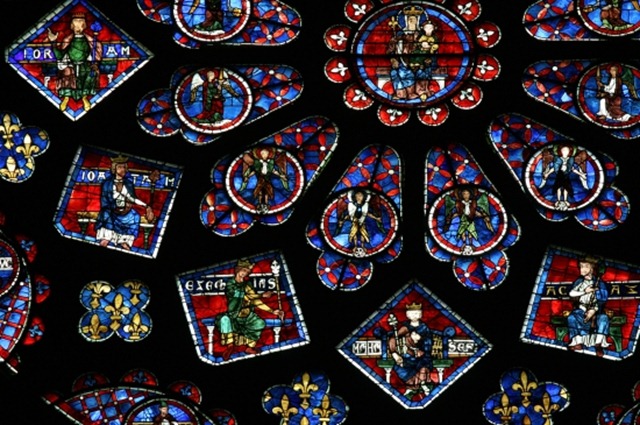


The Notre Dame de la Belle Verrière (Our Lady of the Beautiful Stained Glass Window) or the Blue Virgin window is the second window found in the Southern ambulatory. It dates to Romanesque times. Great mystery has surrounded the how's and why’s of how such brilliant colors were created during that time frame. It has been described as “The most beautiful stained-glass window in existence.” I myself agree. Again, the peace I felt upon viewing such beauty was indescribable. The window has been deemed sacred given that it survived the devastating fire of 1194 that ravaged a good portion of the cathedral.

Of course you must be eager to see the Sancta Camisia (cloak or veil of Mary) which also miraculously survived the June 10, 1194 fire which began by a bolt of lighting. Indeed the cathedral you see today was built in order to house the tunic in all its miraculous glory.


There is a movie, “Two For The Road”, which stars the delightful Audrey Hepburn and Albert Finney. During a visit to the cathedral Finney’s character turns to Hepburn’s and says “Nobody knows the names of the men who made it. To make something as exquisite as this without wanting to smash your stupid name all over it. All you hear about nowadays is people making names, not things.”
Imagine a world where beauty is created simply for beauty and not fame. Today let’s try to create some form a beauty without the sake of recognition.
Laura and Andrea

The town itself is unassuming, even faintly familiar in its charm, but then you turn a corner and suddenly face two towering spires. One, a rather plain pyramid, rises 349 feet (105 m) into the air and dates to the 1140’s and the other, a more flamboyant younger sister, built in the 1500’s, juts up 377 feet (113 m) into the sky.
The exterior of the building is primarily French Gothic in style. It features large hand carved stone blocks which have been transformed into magnificent flying buttresses, round and Gothic pointed arches, and swirling spires topped by a copper roof which is supported by a network of cast iron ribs. What makes Chartres Cathedral truly a wonder is that it is almost perfectly preserved in its original design and very few changes have been made to the interior or exterior. The cathedral has survived several revolutions and wars by what can only be considered the Grace of God. I encourage you to read further on the stories of survival which are miracles in and of themselves.
Chartes Cathedral has a total of nine portals (doorways). The cathedral is unique in that the front portal, also known as the Royal Portal, features a three portal layout which faces west. The sculptures on the Royal Portal primarily feature Jesus and Mary. The center portal depicts the Last Judgment and features Christ in the tympanum (a semi circular decorative wall element located within an arch or pediment) surrounded by symbols of the four evangelists, Matthew, Mark, Luke and John. How does one dare enter such overwhelming loveliness?
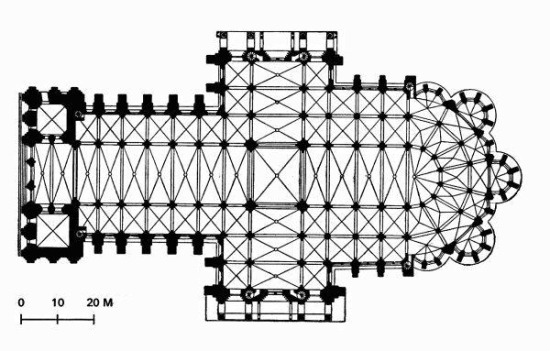
The floor plan of the cathedral is laid out in the cruciform style. You enter into a two bay narthex (entrance) on the west end. This opens up into a seven bay nave (the central approach to the altar) which is the widest in France. This leads to the transept (an area set crosswise in an nave) which features three bays on both the north and south sides. The nave ends in a semi circular apse (semicircular recess) which also features several bays.
But all of this doesn’t really matter when you see it. Upon first entering the cathedral I was so filled with awe that such a structure had not only been created, but had continued to stand for over 800 years. The cathedral was truly majestic. Above all, the overwhelming peacefulness I felt in this grand space and the true gift of seeing SUCH beauty made me weep with joy.
The columns are just massive. The hand carved detailing amazing. But in quaint contrast were rows upon rows of simple rush seat chairs set out for the faithful.

However the chairs hid a secret. On the floor of the cathedral is a labyrinth.
Unlike so many of the ancient cathedrals, Chartes is rather bright due to the 176 stained glass windows that grace the walls. There currently is an extensive effort to rid the cathedral of its centuries of grime. Given that entrance to the cathedral is free, Andrea and I made sure to leave several coins in various boxes to help contribute to the efforts.

The screen which surrounds the choir, known as the chancel screen, features 16th-century sculptures.
To walk around the entire screen is to walk through the bible.
The sculptures are just RIGHT THERE before you. Some have been damaged over the years, no doubt by overzealous pilgrims. I decided to keep my hands to myself and just enjoy the beauty and pray that it remains as such for others.
The stained glass is beyond comparison to any other I have seen before. The tiny shards of jewel toned glass are amazingly intricate and provide outstanding detail in minute form. Yet the overall finished example is nothing short of spectacular. There are a total of three rose windows within the cathedral. The rose window below was a gift from Queen Blanche of Castille in 1230 A.D.
Ever closer you can begin to appreciate the delicate details that make up the overall beauty of this masterpiece.
The intricacy of art form and what it took to create the Adam and Eve panel astounds me. Remember, this window was created in 1230. Long before any advancements in the technique of creating stained glass existed.
At the top of the rose sits King David, in what I would consider his greatest glory. Have you EVER seen such a gem?
But there was one window that left me breathless, as it has for million of pilgrims before me. I had her to myself for a good long while.
The Notre Dame de la Belle Verrière (Our Lady of the Beautiful Stained Glass Window) or the Blue Virgin window is the second window found in the Southern ambulatory. It dates to Romanesque times. Great mystery has surrounded the how's and why’s of how such brilliant colors were created during that time frame. It has been described as “The most beautiful stained-glass window in existence.” I myself agree. Again, the peace I felt upon viewing such beauty was indescribable. The window has been deemed sacred given that it survived the devastating fire of 1194 that ravaged a good portion of the cathedral.

Of course you must be eager to see the Sancta Camisia (cloak or veil of Mary) which also miraculously survived the June 10, 1194 fire which began by a bolt of lighting. Indeed the cathedral you see today was built in order to house the tunic in all its miraculous glory.
You cannot get any closer than what the gates will allow. I found the following image of this close up thanks to the internet.
There is a movie, “Two For The Road”, which stars the delightful Audrey Hepburn and Albert Finney. During a visit to the cathedral Finney’s character turns to Hepburn’s and says “Nobody knows the names of the men who made it. To make something as exquisite as this without wanting to smash your stupid name all over it. All you hear about nowadays is people making names, not things.”
Imagine a world where beauty is created simply for beauty and not fame. Today let’s try to create some form a beauty without the sake of recognition.
Laura and Andrea

Subscribe to:
Posts (Atom)

 Posts